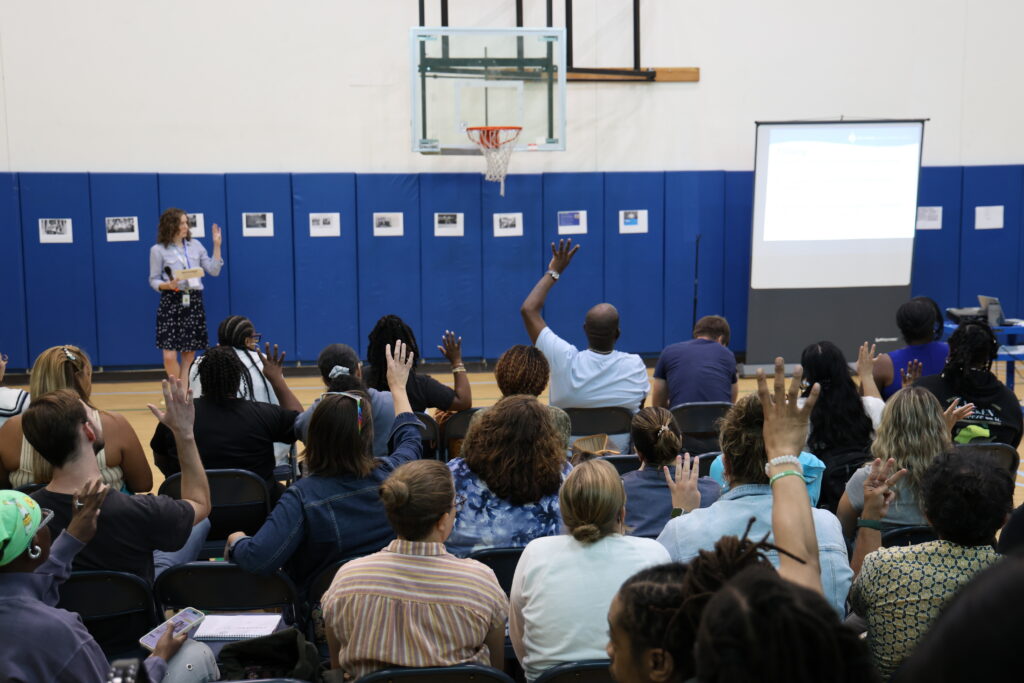
Continuous learning shows up frequently in the halls of Two Rivers, not just for students, but for teachers as well. Two Rivers’ approach to adult learning simply isn’t a one-off workshop or a mere compliance effort, rather it is an opportunity for teachers to engage in deep discussion and inquiry.
Through grappling with ideas, analyzing real classroom work, and reflecting on instructional style, teachers continue to develop and refine their abilities to suit the academic rigor at Two Rivers. More than that, each session provides a space for collaboration and learning best practices that teachers can use in their own personal and professional journey.
Strategy
Year two of the strategic plan is in full effect. School leaders and administration are focused on this year’s core practices: delivering effective lessons, providing differentiated instruction, and crafting and using learning targets during instruction.
Two Rivers’ philosophy relating to the structure and facilitated sessions of adult learning is rooted in the philosophy of the Bright Morning team. Many of the facilitators have been trained to effectively communicate and formulate sessions that foster sustained learning, growth, and connection.
Collaboration Meets Solution
Instead of passively receiving information and leaving staff to interpret it alone, data becomes the starting point for school-based and cross-campus collaboration that leads to meaningful solutions. This process allows teachers to bring diverse perspectives and experiences to instructional challenges. Director of Math (4-8), Tai Carson, says, “We want teachers to learn from each other, analyze student thinking, and test new instructional moves in their classrooms; this cycle of learning, trying, reflecting, and refining makes the work feel real and impactful, and it builds a culture where teachers see themselves as learners alongside their students.”
The flow of this model truly signifies the strength and spirit of Crew at Two Rivers, supported through several fellowships, including literacy, STEM, and co-teaching.
Keep reading to learn more about key aspects of the Two Rivers Professional Learning Model:
| Fellowship/Cohort Model Learning | |
|---|---|
| How Teachers Engage in the Fellowship | The Impact |
| 1. Teachers may observe each other’s instructional style 2. Teachers may analyze students’ work collaboratively 3. Teachers may offer feedback on ways to support students’ needs when it relates to digesting complex content 4.Teachers may engage in shared learning, analyze data, and incorporate evidence-backed tier-1 practices as they grow in their practice | 1. Conversations move from surface-level to deeper reflection 2. Teachers implement ideas from one another’s classrooms into their own 3. Teachers speak intentionally about student thinking and instructional moves 4. Stronger outcomes for students (e.g., positive growth in BOY, MOY, EOY testing) |
For teachers who are not part of a fellowship cohort, school-based professional learning days become even more important.
| School-Based Collaboration | |
|---|---|
| What this collaboration focuses on | The Impact |
| 1. Grade band collaboration 2. Discussing content-specific work | 1. Stronger alignment across grade levels and clearer expectations for student learning 2. Teachers deepen their content knowledge and refine instructional strategies |
In addition to school-based collaboration, multiple campuses join together to view data through a network lens and collaborate on meeting the needs of our students as a network. This includes work related to race & equity work, SEL, and department needs based on our network data. Together, all initiatives create an environment where learning feels impactful and is intentionally supported.
Feedback and Optimization
Meeting staff professional learning needs is a top priority. Each year, a steering committee collects staff feedback after each session to understand what is working and where improvements are needed. After reviewing the data, leaders refine future sessions to better address gaps and strengthen the overall learning experience.
Here is what the data shows:
| Perception Snapshot (Year to Date) | Application of Learning (YTD Distribution) |
| 1. Overall perception of professional learning remains strong 2. 85%+ report sessions are clear and meaningful 3. 81%+ report learning design reflects adult learning principles. 4. 88%+ report facilitators are skillful and responsive. 5. 96–100% combined Yes/Somewhat across experience indicators The foundation of trust in facilitator expertise and clarity is solid. | Here is where perception meets impact: 1. 40% report Significant integration 2. 41% report Moderate application 3. 14% Slight 4. 4% None |
Continuous learning, collaboration, and constructive feedback are what make adult learning at Two Rivers so unique. Through fellowships and school-based and cross-campus collaboration, teachers strengthen their practice and deepen their understanding of student learning. This commitment to growth mirrors the same values we expect for students.
~Isa Walker, Communications Associate